// our approach
AI Incubator
Built for young innovators
Ages 7-11
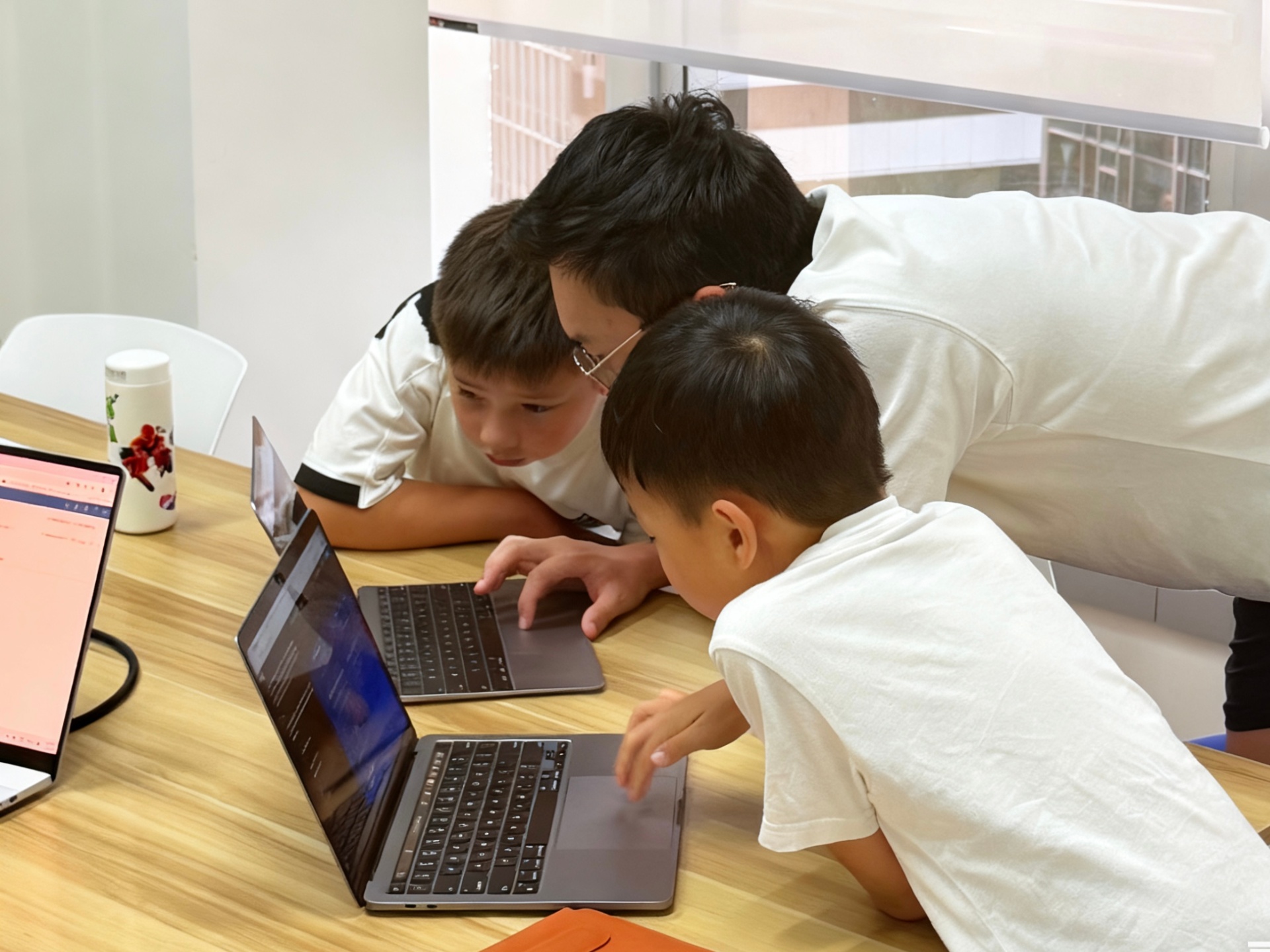
AI is the present, not the future. We teach kids to think with AI — understand how it works, use it confidently, and stay safe doing it.
Plus the soft skills that matter in any career: critical thinking, project planning, prompting, presentation and debate.

What this course is not
This is not a coding or robotics class. Students will not write Python, build robots, learn Scratch, or use AI to shortcut their homework.
Instead we focus on something more fundamental: how to think with AI. AI tools will change many times in the coming years — we prepare students for that.
Requirement: a solid foundation in English (sentence structure, grammar, tenses, vocabulary).
// at a glance
Course at a glance
7–11
Age range (recommended start: 7–8)
9
Learning modules across 3 sections
2
Final projects to combine all skills
0
Coding required — focus is on understanding AI
What your child will learn
- • How AI already exists in everyday life — and how it actually works
- • How to use AI as a tool that helps, not replaces, them
- • Creating real outputs: images, videos, stories and websites
- • AI ethics: bias, limitations and why blind trust is dangerous
- • Internet & AI safety, blended into every module
- • Critical thinking and project management through hands-on frameworks
// what they learn
9 Course Modules
Three sections, nine modules. Each module includes its own mini-project so students apply what they learn straight away.
Section 1 · AI Foundations
What is AI and How Does It Think?
- What AI is and where it already exists in daily life
- Common misconceptions about AI
- The stages of AI: past, present and near future
- How AI makes decisions vs. how humans do
Section 1 · AI Foundations
How AI Learns: Data, Patterns and Models
- Machine learning explained simply
- Training data, pattern recognition and model building
- Why data quality matters
- How AI learns to see, hear and read
Section 1 · AI Foundations
Talking to AI: Prompting Fundamentals
- What LLMs are and how they generate responses
- How to structure good prompts
- Safe AI use: what not to share
- When to verify and how to spot a wrong answer
typical paceBy age 8Complete Module 3
Section 2 · AI In The Real World
AI-Generated Media: Images, Audio, Video & Deepfakes
- How AI generates images, music and video
- The mechanics of deepfakes
- How to identify AI-generated content
- Real-world consequences of synthetic media
Section 2 · AI In The Real World
Using AI Safely: Ethics, Privacy & Responsible Use
- What data you give away when you use apps and AI tools
- Bias, fairness and accountability
- Setting boundaries with AI
- Building healthy habits with technology
Section 2 · AI In The Real World
AI Around You: Applications, Chatbots & Project Planning
- How recommendation engines work
- How algorithms build a profile of you
- Introduction to project planning
- Project: design and build your own chatbot
typical paceBy age 9Complete Module 6
Section 3 · Advanced Future AI
Staying Safe Online: Internet Dangers & Project Planning 2
- Phishing, fake websites, keyloggers and social engineering
- How personal data is stolen
- Live hacking demos
- Converting user needs into product features
Section 3 · Advanced Future AI
AI in Industry and the Future
- How AI is transforming different industries
- The skills that remain uniquely human
- Judgment, creativity, empathy and ethical reasoning
- The future of work
Section 3 · Advanced Future AI
Advanced Prompting and Building with AI
- Advanced prompt structures
- Using AI to check, improve and build on your work
- Intro to vibe-coding
- Build a basic working product without code
typical paceBy age 10Complete Module 9
// expected progress A simple guide based on a recommended start at age 7–8. Placement may vary by experience.
// taught by
Educators who actually build with AI every day.
// parent questions
Parent questions, answered
The questions parents ask us most about AI for young learners.
Is AI safe for my 7-year-old to use?
With guidance, yes. Safe use is built into the course — students learn what never to share online, how to set boundaries with AI tools, and how to build healthy technology habits from day one.
My child has no coding experience. Can they still join?
Absolutely. The AI Incubator has no coding requirement — the focus is on understanding how AI works and using it well. Students who catch the coding bug can move on to our coding tracks later.
Will AI give my child wrong or inappropriate answers?
Sometimes, and that's part of the lesson. Students learn why AI makes mistakes, how to spot a wrong answer, and when to check with a trusted adult — skills they'll use every time they pick up a device.
What personal data does my child share when using AI tools?
We teach exactly this. One module covers what data apps collect, what should never be shared, and how algorithms build a profile of you — so children understand privacy before they use AI on their own.
How do you teach children about deepfakes and fake content?
Module 4 shows how AI-generated images, audio and video are made and how deepfakes work — then students practise identifying synthetic content and discuss its real-world consequences.
How many students are in a class?
A maximum of 6, so every child gets attention and every question gets answered.
What will my child actually make?
Every module includes a mini-project. By the end of the course, students design their own chatbot and build a basic working product — no code needed.
Which class is right for my child's age?
We place students based on age and experience. Reach out on WhatsApp and we'll recommend the right starting module and class.
// pricing & policies
Fees, discounts & class policies
// class fee
$6,000
per student, per module
Summer classes only
All-inclusive: tech platform subscriptions and tooling fees are covered. No hidden costs.
Class size
Max 6 students
Regular semester classes: $7,200 / module (12 hours of instruction).
Discounts & offers
EARLY BIRD
10% OFF
Sign up before 10 June.
PRIVATE CLASS
10% OFF
Form your own class of 5+ students.
BUNDLE 2 MODULES
10% OFF
Discount applies to your second module.
Good to know
- Bring your own device. Each student needs an iPad or laptop.
- Modules are sequential. Modules 1 & 2 must be completed before starting Module 3, and so on.
// don't see what you need?
Looking for private classes, intro to coding, Scratch or VEX?
We also run private 1-on-1 classes, intro to coding, Scratch and VEX robotics for primary students. Reach out and we'll match your child to the right track.
Ready to start your child's AI journey?
Browse our upcoming AI Incubator schedule or get in touch — we'll help you find the right fit.